
How many meters deep can you see marine life?
Understand how light behaves underwater, why colors fade with depth, and why the best dives happen in the ocean's 'living zone.'
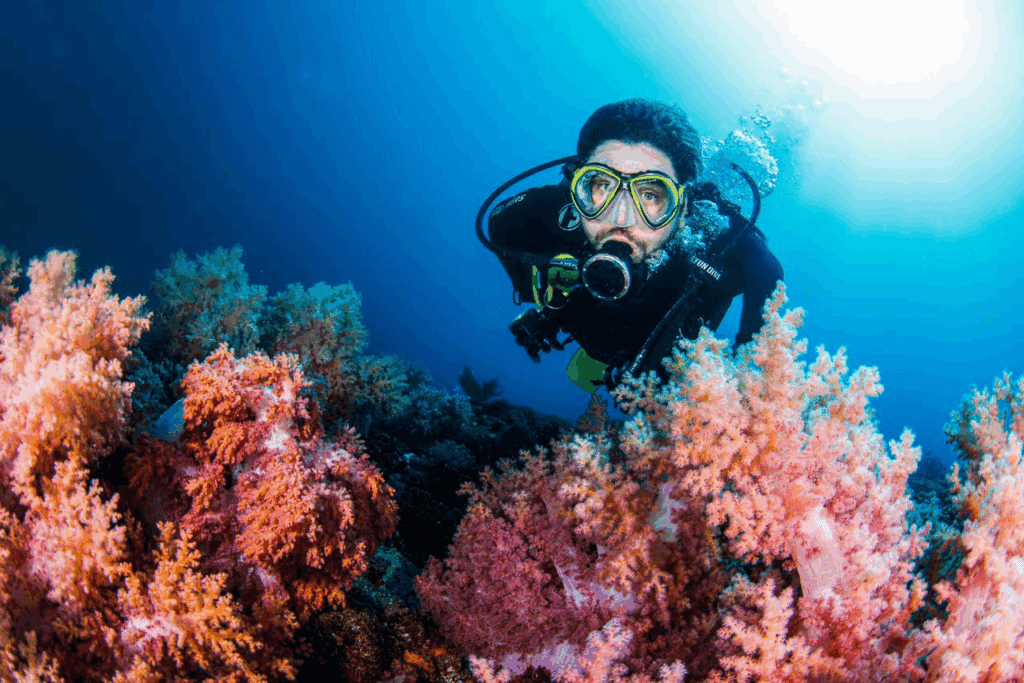
A common question from new divers is: how deep can you actually see anything underwater? The answer has less to do with depth by itself and more to do with something a lot of people don't think about: sunlight behaves very differently underwater than it does in air.
As soon as light enters the water, it starts getting absorbed — and not evenly across colors. Red is the first color to disappear, usually by around 5 meters (16 feet) of depth. Orange and yellow fade next, and green last, leaving mostly blue, which is the color that penetrates deepest into the water column.
That's why photos and video shot without artificial light get increasingly blue-green as depth increases — it's not a camera effect, it's exactly what the eye sees underwater without its own light source or a red filter to compensate for the lost color.
That doesn't mean it goes dark quickly, though. Sunlight keeps penetrating the water and gradually dimming with depth, even at high noon — just with less and less intensity and an increasingly narrow color spectrum. That's why, even without a flashlight, a diver can still make out shapes, movement, and plenty of marine life well below the 5-meter mark where red already disappeared.
It's precisely because of that remaining light that recreational diving, by definition, happens within roughly the top 40 meters of the water column. That's not just about safety and decompression limits — it's also because that band is where enough ambient light still exists to comfortably observe the reef, fish, and the rest of the marine life without relying entirely on lighting equipment.
Within those top 40 meters, in fact, is where most of the marine life divers actually see is concentrated — corals, schools of fish, sea turtles, and the vast majority of species that draw recreational divers all live in that lit zone. Shallower dives, like the ones typical of sites around Búzios, tend to have even more vivid colors precisely because they're closer to the surface, where the full light spectrum is still present.
In practice, that's good news for beginners: you don't need to go very deep to see a lot. Most of the most vibrant marine life — and the best photos — happen well within the recreational diving range, with nothing more than basic gear.
You might also like
The best dive sites in Búzios
A tour through the main dive sites around Búzios — what to expect in terms of visibility, marine life, and difficulty at each one.
Why go on a night dive
The same dive site turns into a different world after sunset. Discover what makes night diving such a unique experience.
Diving in Búzios: what to expect
An honest introduction to what makes Búzios such a sought-after diving destination — no exaggerated promises, just what's genuinely worth knowing before you go.