
How divers communicate underwater
You can't talk underwater, but you can communicate very well — meet the standard hand signals used on every dive.
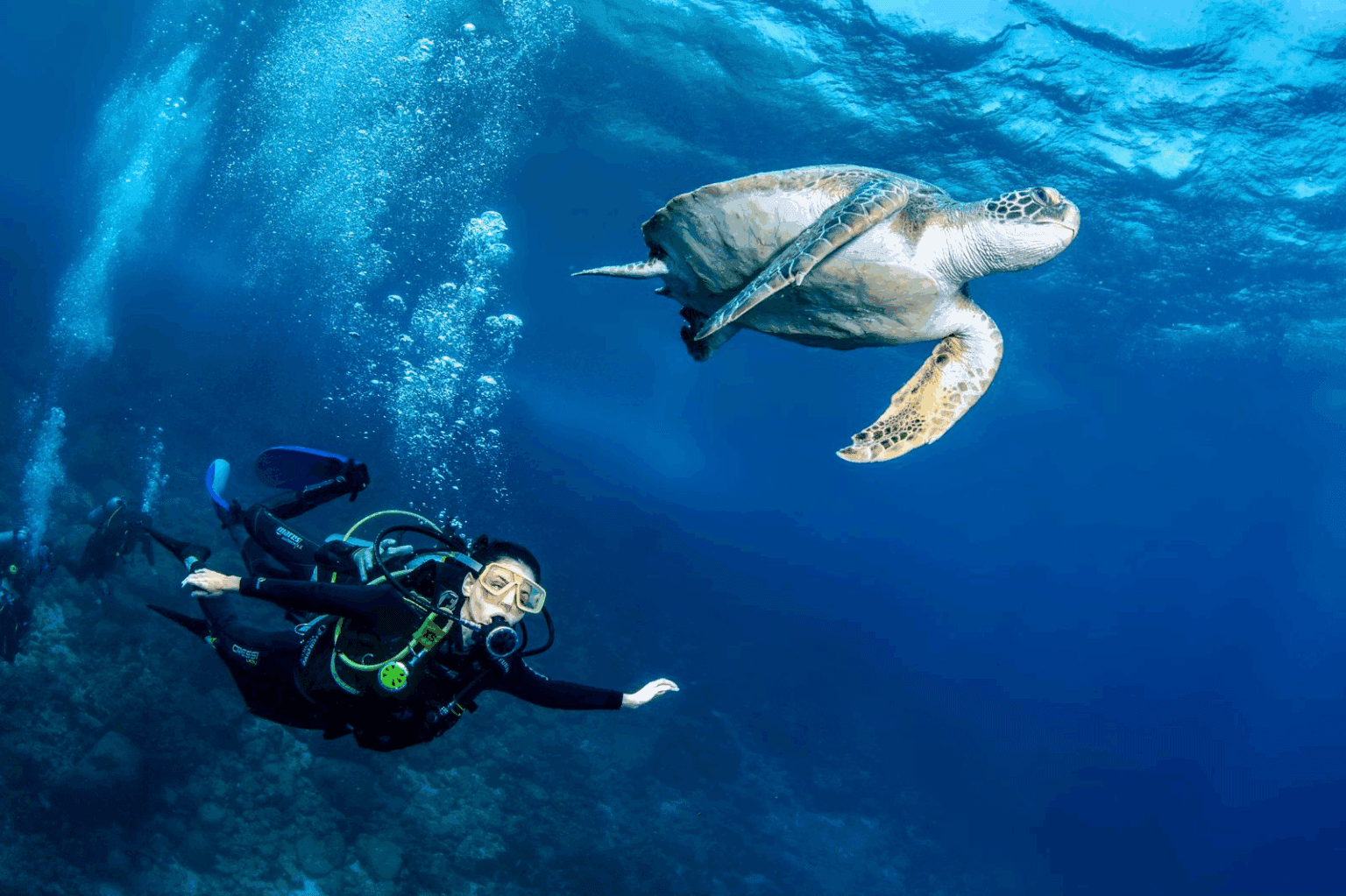
How divers communicate underwater is one of the first things any introductory course teaches, because clear communication is essential for the safety of the whole buddy team or group. With a regulator in your mouth and no way to talk normally, divers rely on a set of internationally standardized hand signals, recognized by any certified diver or instructor anywhere in the world.
The best-known signal is 'OK': thumb and index finger forming a circle, with the other three fingers extended. It works both to ask 'are you okay?' and to answer 'yes, I'm okay' — always given clearly, at a height where your buddy can see it. If the response isn't that signal, the instructor or buddy already knows to check the situation more closely.
To indicate something isn't quite right, without necessarily being an emergency, the signal is a flat, open hand rocking side to side, like a 'so-so.' A real air emergency — when the tank is empty or nearly empty — is signaled by slicing a flat hand horizontally across the throat, an unmistakable gesture that triggers air-sharing protocols immediately.
There's also a signal for asking or reporting how much air is left in the tank: usually a closed fist with the thumb pointing toward your own gauge, or a question-mark gesture with the index finger followed by a pressure-check motion. Buddy teams typically check each other's air levels regularly throughout the dive, not only when someone asks.
For depth guidance, the signals are simple and intuitive: thumbs up means ascend or end the dive, and thumbs down means descend. To indicate direction or point out something interesting — a school of fish, a turtle, a coral formation — a diver points with an extended index finger, often followed by the 'look' signal (two fingers pointing at your own eyes, then at the object).
Other common signals include the cold gesture, made by hugging your own arms around your body, and the 'stay together' or 'buddy up' signal, made by hooking the index fingers of both hands together — important for reinforcing that the team shouldn't drift apart. Instructors typically review these signals during the briefing before each dive, especially when there are site-specific or activity-specific signals to add.
Beyond hand signals, divers have backup tools for more detailed communication: slates or 'wetnotes' — small submersible writing boards — are useful for conveying more specific information, like a depth number or a species name. Dive computers also help communication indirectly, since each diver tracks their own depth, time, and decompression data, reducing the need for constant questions to a buddy.
In the end, underwater communication works well precisely because it's simple, standardized, and practiced. A diver who has these basic signals down can communicate with any buddy, anywhere in the world, even without sharing a language on the surface — and that's part of what makes diving such a universal activity.
You might also like
Why the pre-dive safety check matters
Meet BWRAF, the buddy check PADI teaches before every dive — and why even experienced instructors never skip it.
How does a scuba dive actually work?
From the first briefing on the sand to the return to the boat: understand the step-by-step of a recreational dive, no mystery involved.
What you need to know before your first dive
Common questions from first-timers — health, fear, ears, glasses, and what actually matters before getting in the water.